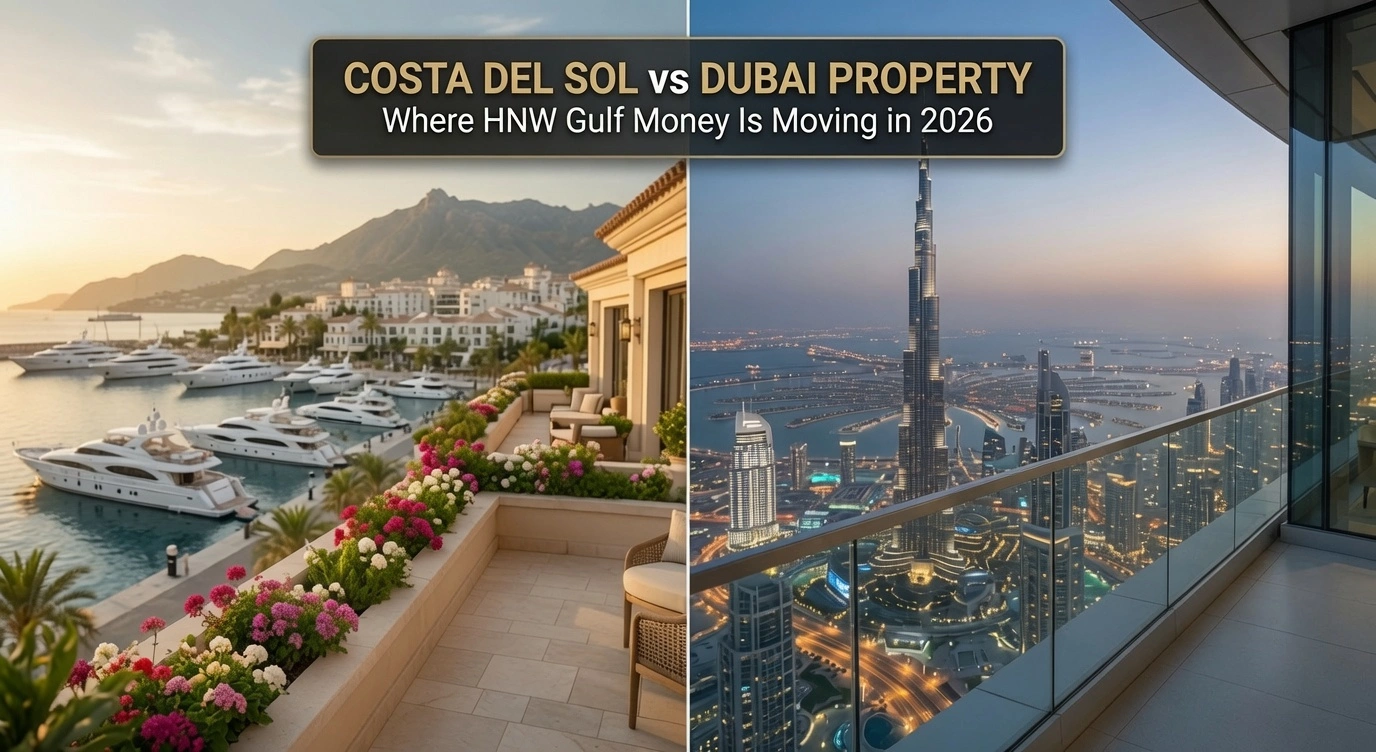

Marbella is the established luxury play. Estepona is the faster-growing value bet. 2026 price data, foreign-buyer share, and rental yields compared — pick the right Costa del Sol town.
🏛️ The Two Markets at a Glance
Both towns are in the province of Málaga, both are within 30 minutes of the airport, both have the Mediterranean at their doorstep. That is where the overlap ends.
The headline numbers explain a lot. Marbella's premium reflects decades of brand equity built around Puerto Banús, the Golden Mile, and the international school ecosystem. Estepona's lower base price, combined with its faster growth, is what has pulled serious institutional attention to the western stretch of the New Golden Mile over the past 36 months.
💶 Price Per Square Meter: 2026 Snapshot
Micro-location matters more than the town label. A frontline beach apartment in Marbella's old town is not the same asset class as a townhouse in Cancelada. The breakdown below reflects 2026 resale data across the principal subzones.
Two patterns are worth flagging. First, the New Golden Mile (Estepona) now overlaps the upper end of Marbella's eastern subzones on price — the gap that justified calling it the "value play" has narrowed. Second, Marbella's premium is concentrated in the Golden Mile and the gated hillside communities; the rest of the municipality trades at levels increasingly comparable to prime Estepona.
📈 Price Growth: 2022 to 2026
The pandemic reset the Costa del Sol market. Both towns saw a step-change in 2022 and 2023, then a steadier climb in 2024 and 2025. Estepona is the structural outperformer; Marbella is the steady compounder.
Estepona's growth premium is not accidental. It reflects three concrete drivers: a lower entry price (more room to compound), a denser pipeline of new-build developments on the New Golden Mile, and the Estepona town hall's decade-long programme to pedestrianise and refurbish the casco antiguo. Marbella's growth is steady, but the percentage runway is structurally smaller from a higher base.
🌍 Who Is Buying: Foreign Buyer Profile
Both towns skew foreign, but the nationality mix differs and so does the use case.
Marbella
Marbella's foreign buyer base is heavily British, German, Scandinavian, and — increasingly — North American. The dominant purchase motive is lifestyle with a secondary yield on rental when the property is not in use. Most prime-zone buyers spend €1.5M to €6M on villas or frontline apartments, often with cash, and use the property 6 to 10 weeks per year. The buyer profile skews older (45 to 70) and the rental market is anchored in summer lets, with shoulder-season occupancy improving each year.
Estepona
Estepona's foreign buyer base is more mixed geographically — a larger share of Belgians, Dutch, Irish, and Eastern European buyers — and the use case tilts more toward permanent relocation, family lifestyle, and year-round rental. The buyer profile skews younger and more working-age. This is also the town where more Spanish-resident foreigners (EU citizens with NIE, typically) are buying, which removes the non-resident tax friction and broadens the financing options.
🏠 Lifestyle and Practical Differences
For families with school-age children, the international school density around Marbella is the single most important factor and is very hard to replicate elsewhere on the coast. Estepona's Atalaya International School is solid for primary and lower secondary, but for older children most Marbella-resident expats commute to Aloha or Swans. This is a 25 to 40 minute drive, not a walk.
🎯 The Investment Verdict
Different bets, both defensible.
Marbella is the right answer if your priority is capital preservation with a modest yield, or if the property is also a primary or secondary residence for your own use. The liquidity is unmatched — reselling a prime Marbella property in any market cycle is faster and cleaner than reselling a comparable asset in Estepona. The premium is real, the brand is real, and the rental infrastructure (luxury short-let agencies, concierge, key-holding) is mature. The annual capital growth case is 5% to 8% in a normal market, with lower tail risk.
Estepona is the right answer if your priority is compounding yield from a lower entry base, or if the property is a full-time rental, relocation, or family residence rather than a holiday home. The growth has been structural, the rental yields are 100 to 150 basis points higher on a like-for-like property, and the long-term tailwind from the town hall's investment in public realm is real. The annual capital growth case is 8% to 12% in a normal market, with moderately higher cyclical volatility because the buyer base is broader and the developer pipeline is heavier.
Neither town is a bad answer. The question is which curve matches your capital and your time horizon.
✅ Action Steps for Buyers in 2026
- Decide the use case first — holiday home, full-time relocation, or pure investment. The town and subzone should follow, not lead.
- Pull 12 months of comparable sales at the subzone level, not the municipality level. The town label is a marketing signal; the data is at the subzone.
- Run the cost calculator (ITP, notary, registry, legal, mortgage) at your target price. The 9% to 11% on top of the purchase price is the realistic budget, not the headline.
- Engage a flat-fee Costa del Sol property lawyer for the title search and contract review. Hourly billing is a red flag for a property transaction.
- Visit the property in two seasons before committing — high summer and shoulder season. Tourist areas feel different when the holiday lets are not at 100% occupancy.
- For pure investment plays, model the 5-year net total return: capital growth plus net rental yield minus holding costs minus a 5% liquidity discount on exit.
🔍 The Bottom Line
Marbella is the Costa del Sol's most liquid, most branded, and most expensive market. Estepona is the fastest-compounding market at a lower entry point, with a deeper year-round rental pool and a younger buyer base. The right answer depends on whether you are optimising for capital preservation with prestige (Marbella) or compounding yield from a growth market (Estepona).
The numbers in 2026 favour Estepona for pure capital growth. The institutional, regulatory, and brand moats favour Marbella for capital preservation. Most international buyers who intend to use the property themselves end up in Marbella. Most international buyers who treat the property as a financial asset end up in Estepona. Both are defensible. The mistake is to choose the town before you have decided the use case.
A local agent working across both municipalities can run the same data for the same budget and show you three to five properties that meet your criteria. That comparison is the only way to make a confident decision — and it costs nothing more than the time of one viewing trip.
📞 +34 624 770 233 · WhatsApp · 📧 info@cerealestates.com
🌐 Request a Property Consultation
Ready for the lifestyle?
Download our exclusive free guides to learn everything about living and investing in Spain.
Explore Expert Guides